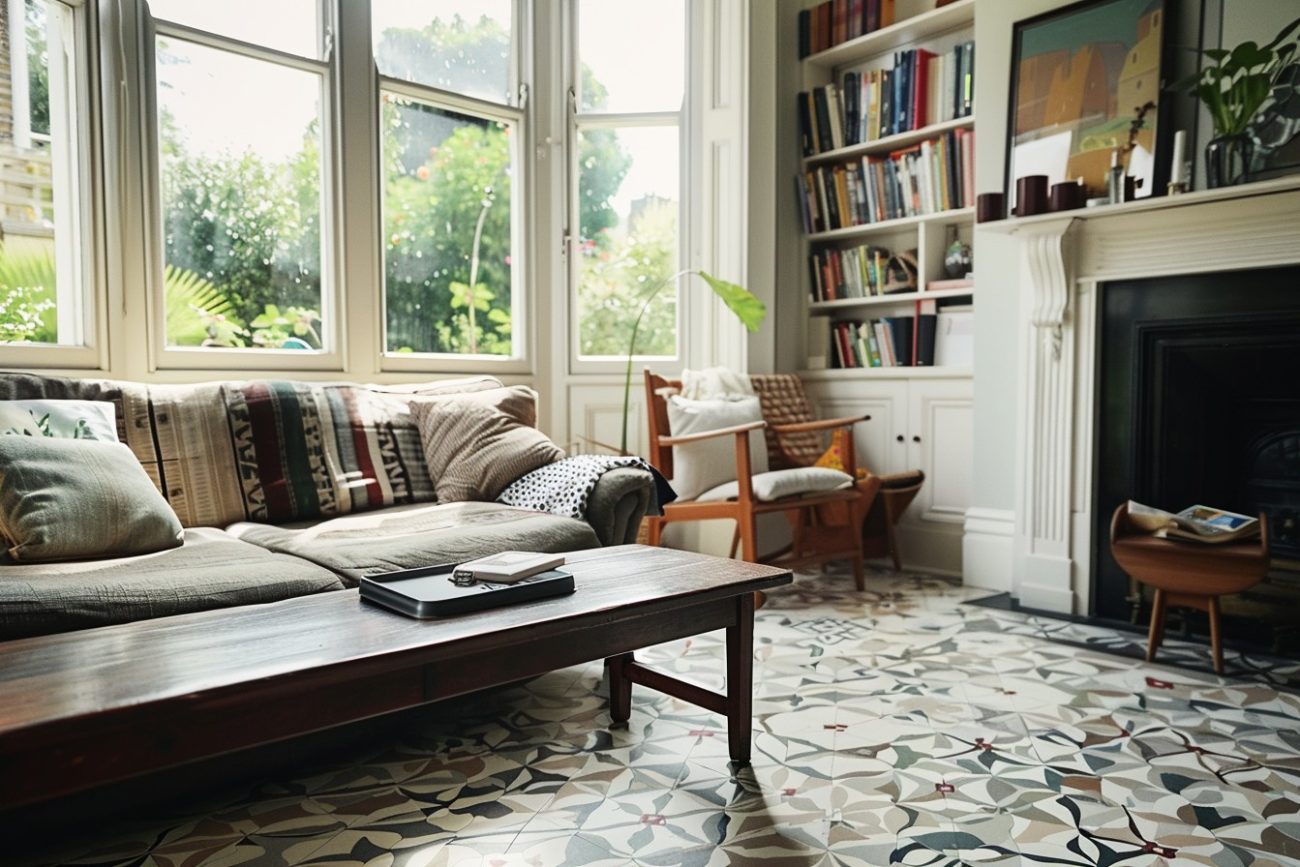
There is a particular moment that happens on certain jobs – usually within the first minute of walking through a front door – where you look down and stop. Not because of what is wrong, but because of what is there. An entrance hall floor in original Minton encaustic tile, the pattern still crisp, the colours still rich after a hundred and forty years of foot traffic. Or a lower-ground kitchen with slate flagstones worn smooth in the middle and rough at the edges, where generations of footfall have polished the stone in the exact places people always stood. These floors are not decorative features that were chosen. They are what was always there, and they have simply survived.
Hampstead and Highgate are full of them. The period properties that line the streets between the Heath and Highgate Hill were built at a time when entrance-hall tilework was a mark of craft and civic pride, and when lower-ground floors were laid in natural stone expected to last indefinitely. In a great many cases, they have. The problem is not that these floors have failed. The problem is that they are cleaned by people who do not know what they are standing on.
Unlike antiques displayed on shelves or locked in cabinets, floors receive no such deference. They are walked on, mopped, and subjected to whatever product happens to be under the sink. The damage done to original Victorian floors by well-meaning but uninformed cleaning is, in my experience, second only to bad building work. This article is about how to stop adding to that total.
The Floors You Find in Hampstead and Highgate Period Homes
Period properties in this part of London tend to have two distinct categories of original floor, each made from different materials and each requiring a completely different approach. Treating them as interchangeable is where most of the trouble begins.
Entrance Halls – Encaustic Tile and Geometric Minton
The tiled entrance hall is one of the most recognisable features of the Victorian terraced house, and in the better-preserved streets around Hampstead Village and the Highgate conservation area, a significant number remain fully or largely intact. These floors are typically made from encaustic tiles – unglazed ceramic tiles in which the pattern is formed by inlaying different coloured clays before firing, so that the design goes all the way through the body of the tile rather than sitting on a surface glaze that can be worn away. Manufacturers like Minton, Maw & Company, and Craven Dunnill produced them by the million in the latter half of the nineteenth century, and the geometric patterns they came in – chequered, diagonal, floral, and interlocking star designs – were fitted across London homes at every price point.
Because they are unglazed, encaustic tiles are porous. They absorb liquids, oils, and cleaning products directly into their body, and they will hold whatever is introduced to them for a very long time. They are also, when properly cared for, extraordinarily durable – which is why so many of them are still here.
Stone and Slate in the Lower Ground
Below the ground floor, in the kitchen and utility spaces that occupy the lower ground level of most Hampstead and Highgate period properties, the original flooring is more likely to be natural stone – Yorkshire sandstone, blue slate, or dark limestone – laid in large irregular or cut flags directly onto a sand and mortar bed. These floors were designed to be practical and almost indestructible, and by and large they are. What they were not designed for is the range of modern cleaning products and methods now routinely used on them.
Natural stone floors in lower-ground spaces also exist in an environment of higher ambient moisture – for the same reasons discussed in relation to basements generally. They need to breathe. Any sealant that prevents them from doing so will trap moisture within the stone and beneath the flags, eventually causing the mortar bed to deteriorate and the flags to lift.
What Damages Period Floors
The damage done to Victorian and period floors does not usually come from neglect. It comes from active, regular cleaning carried out with entirely the wrong materials and methods. The floor survives a century of hard use and is then quietly destroyed in a decade of conscientious maintenance.
The Wrong Products and What They Actually Do
Bleach is as destructive on natural stone and unglazed tile as it is on marble – it reacts with the minerals in the material, leaching out the natural colour variation and etching the surface at a level that no resealing will restore. Vinegar and other acidic cleaners do the same, and are particularly damaging on limestone, which is highly calcium-based and reacts immediately to acid contact.
Oil-based soaps will permanently darken porous encaustic tiles if used without restraint, leaving greasy residue in the body of the tile that builds up with each application and cannot be removed without aggressive stripping that risks the tile surface itself. Strongly alkaline cleaners – including some labelled specifically as stone cleaners – will, over time, draw the natural salts within the stone to the surface, producing a white crystalline efflorescence that disfigures the floor and signals deeper structural disruption.
Water, Steam, and Saturation
Steam mops have become a fixture of modern cleaning routines, and they are among the most reliably damaging things you can use on a Victorian period floor. The thermal shock of intense steam on old tile can cause hairline cracking, loosen the bond between encaustic layers, and force moisture deep into grout joints where it has no easy means of escape. On flagstone floors, steam drives moisture into the stone, accelerating the freeze-thaw cycle that eventually causes surface spalling and erosion.
Ordinary mopping with excessive water causes similar damage more slowly. A saturated mop head on a Victorian tile floor will fill grout joints with water, soften the original lime mortar, and deposit residue in the porous tile surface with every pass. The floor may look clean. The mortar beneath it is being steadily weakened.
How I Clean Each Floor Type
The shared principle across all period floor cleaning is the same one that governs antique furniture, mirrors, and fireplaces: minimum moisture, appropriate product, applied with patience rather than pressure.
Encaustic and Geometric Victorian Tiles
Begin with a thorough dry sweep using a soft-bristled brush or a dry mop, removing all loose grit before any liquid is introduced. Grit dragged across encaustic tile under a wet mop is an abrasive, and over time it will dull and scratch the surface irreversibly.
For routine cleaning, a pH-neutral stone and tile cleaner diluted in warm water, applied with a well-wrung mop that is damp rather than wet, is correct. Work in sections and dry each section promptly – do not allow water to stand on the tile surface or pool in grout joints. For ingrained dirt in the grout, a stiff natural-bristle brush worked carefully along the joint lines will dislodge compacted debris without the risk of a metal tool scratching the tile edges. Rinse with clean water applied equally sparingly, and dry the floor as completely as possible before it is walked on.
Stone and Slate Flagstones
Flagstone floors respond well to warm water and a very small amount of pH-neutral cleaner, applied with a firmly wrung mop. The goal is to clean the surface, not saturate it. On slate in particular, overwetting will raise the surface grain and leave the stone looking dull once dry – the opposite of the deep, rich finish a properly maintained slate floor should have.
For stubborn staining – grease spots, rust marks, old wax build-up – the appropriate response is a specialist poultice suited to the specific stain type, rather than scrubbing with a stronger general cleaner. Scrubbing damages the surface. Poulticing draws the stain out. The distinction matters considerably on a floor that may be a century and a half old.
Sealing, Protecting, and Long-Term Maintenance
Sealing a period floor is one of the most consequential decisions in its care, and it is frequently done incorrectly – either with the wrong product, at the wrong time, or without adequate preparation.
When and How to Seal a Period Floor
The most important thing to understand about sealing natural stone and unglazed tile is that the sealant must be breathable. Modern polyurethane, epoxy, and vinyl-based floor sealants are entirely appropriate for modern buildings. On a Victorian floor in a period property, they are disastrous – they trap moisture within the material and eventually cause tiles or stone to blister, lift, or crumble from beneath.
The correct product is an impregnating sealant – one that penetrates the body of the tile or stone and repels liquid from within rather than coating the surface. These sealants are breathable, do not significantly alter the floor’s appearance, and need reapplying every few years. Before any sealant is applied, the floor must be thoroughly clean and completely dry – which in a period lower-ground space may mean allowing several days after cleaning before the sealing begins.
Keeping It Right Between Deep Cleans
A period floor that has been properly cleaned and correctly sealed is not difficult to maintain. Dry sweeping or a soft vacuum regularly to prevent grit accumulation, prompt attention to spills, and a damp mop with plain warm water for routine cleaning will keep it in good order between the less frequent deep cleans it periodically needs.
The floors in these houses have already done the hard part. They have survived the building of the Tube, two world wars, and the invention of the steam mop. What they need from us now is simply the patience to clean them on their own terms, rather than ours.
