The first time I watched someone ruin an antique mirror, they did not know they were doing it. They were cleaning a large Victorian overmantel mirror in a house near Fitzjohn’s Avenue – a beautiful piece, gilt frame, original glass with that characteristic slight distortion that tells you it predates modern manufacturing. They picked up a standard glass cleaner, held the bottle about thirty centimetres from the surface, and sprayed. The fine mist settled across the glass, ran to the edges, and seeped behind the frame rebate in a matter of seconds. The mirror looked clean. The damage was invisible, and entirely done.
I think about that afternoon every time I stand in front of an antique mirror with a cloth in my hand, which in London period homes is rather frequently. Mirrors are among the most common significant antiques in the properties I work in across Hampstead, Belsize Park, and the wider north London area – and they are, without question, the most routinely mishandled. People treat them like modern mirrors because they look like modern mirrors. They are not. The glass is different, the backing is different, and the thing that makes them genuinely irreplaceable – the original silvering – is also the thing most easily destroyed by an uninformed clean.
This article explains what you are actually dealing with, why the standard approach goes wrong, and how to clean an antique mirror in a way that preserves rather than diminishes it.
What an Antique Mirror Actually Is
Modern mirrors are made by applying a thin layer of aluminium to the back of float glass in a factory process that produces a uniform, sealed surface. Antique mirrors – anything made before the mid-twentieth century, and particularly those found in Victorian and Edwardian period homes – were made entirely differently, and understanding that difference is not optional if you intend to clean one.
The Silvering and Why It Is Vulnerable
Until the late nineteenth century, mirrors were made using a mercury-tin amalgam applied to the back of the glass by hand. From around the 1870s onwards, silver nitrate solutions replaced mercury in most commercial production – hence the term “silvering” – but the fundamental vulnerability remained the same. The reflective layer sits between the glass and a backing board, sealed only by its own adhesion and whatever protection the frame provides at the edges. It is not bonded to the glass in any modern sense. It is sitting there, held in place by friction and time, and it has no tolerance for moisture, solvents, or anything acidic.
When cleaning products reach the silvering – either through spray drift or by running down the face of the glass to the edges – the damage takes several forms. Immediate blackening at the point of contact is the most obvious. More insidious is the delayed reaction, where the solvent or moisture disrupts the adhesion across a wider area, causing the silvering to separate from the glass slowly over the following weeks or months in a spreading grey-black bloom that is genuinely irreversible.
The Frame – Often as Valuable as the Glass
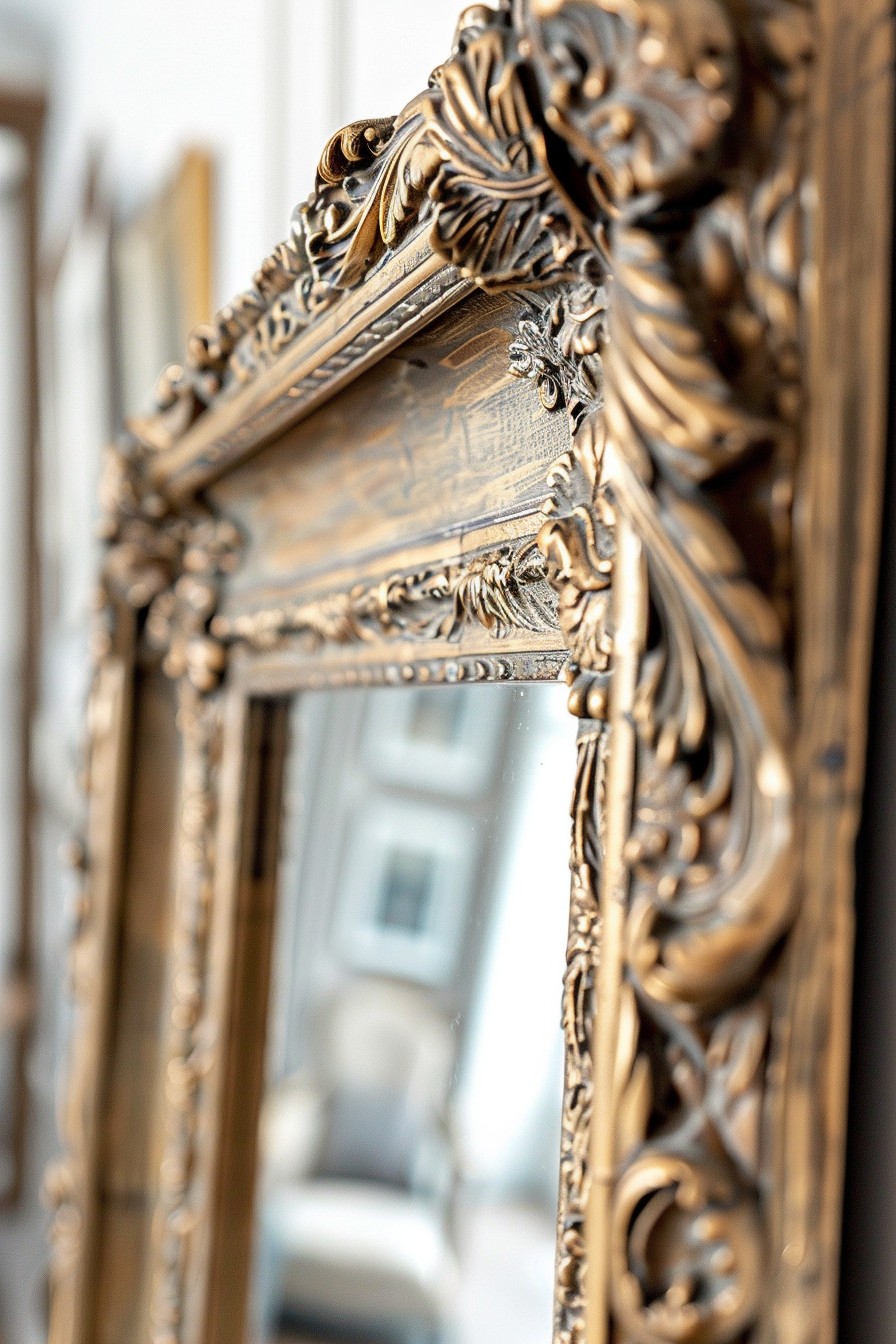
In many antique mirrors, particularly those from the mid-Victorian period onwards, the frame is as significant as the mirror itself. Gilt frames on London period-house mirrors are typically made from carved or composition ornament – a mixture of whiting, resin, and animal glue applied over a wooden armature and gilded with gold leaf. The gilding is extraordinarily thin and extraordinarily fragile. Water loosens the composition beneath it. Alcohol strips the gold. Even a dry cloth applied with too much pressure will lift gilding from raised details that have already become slightly unstable with age. The frame demands as much care as the glass, and different care at that.
What Goes Wrong and Why
The two most common mistakes made when cleaning antique mirrors are not made out of carelessness. They are made by people who are genuinely trying to clean the mirror well. The problem is method, not intent.
The Spray Bottle Problem
Glass cleaner applied by spray is the single most reliable way to damage an antique mirror. The spray format creates droplets that travel beyond the intended area, settle on the frame, and – most critically – produce a fine mist along the edges of the glass that gravity then pulls directly toward the gap between the glass and the rebate. This gap, however tight the frame fits, is the silvering’s only point of exposure. Any liquid that reaches it will wick beneath the glass by capillary action, and once it is in contact with the silvering, the process of damage begins regardless of what the product is. Even plain water, repeatedly introduced at the mirror’s edge, will over time cause the silvering to lift and discolour.
How Liquid Reaches the Silvering
Beyond spray drift, there is a second route that most people do not consider: the pooling that happens when too much product is applied to the glass surface and the excess runs downward. A heavily soaked cloth, wrung out insufficiently before use, will deposit more liquid on the glass than evaporation can handle quickly. The surplus runs to the lowest edge of the frame, collects in the rebate, and sits against the glass until it finds its way through. The lesson is not just to avoid spray – it is to use almost no liquid at all, applied to the cloth rather than the mirror, and never to allow any pooling anywhere on the surface.
How to Clean an Antique Mirror Properly
The approach to antique mirror cleaning is defined by one principle: minimum possible moisture, applied to the cloth and not the glass, kept away from the edges. Everything else follows from that.
Cleaning the Glass
Begin with a completely dry lint-free cloth – microfibre or clean cotton – and wipe the glass surface to remove loose dust and debris before introducing any moisture at all. This step matters because grit on the glass, once a damp cloth is applied, becomes an abrasive. For light soiling, a dry cloth alone is often sufficient on antique glass, which does not need to achieve the streak-free clarity we expect from modern glazing.
For heavier soiling, dampen a cloth – not with glass cleaner, but with distilled water, or at most a solution of distilled water and a very small amount of white vinegar – and wring it out until it feels barely damp. Wipe the glass in slow, controlled strokes from the centre outward, stopping well short of the edges. Never take the cloth to the perimeter of the glass. Use a second dry cloth immediately afterwards to remove any remaining moisture. The result will not look as bright as a modern mirror cleaned with commercial products. It will, however, still be intact.
Cleaning the Frame
For gilded frames, the approach is even more restrained. Loose dust should be removed with a very soft, dry brush – a wide, soft-bristled watercolour brush works well – using light strokes that lift rather than drag. Do not use a cloth on raised gilded ornament. The pressure required to reach into carved details will dislodge gilding that has been sitting perfectly undisturbed for a hundred and fifty years.
For painted or lacquered timber frames that are not gilded, a barely damp cloth is acceptable on flat sections, but the same rule applies: minimal moisture, dried immediately, nothing near the joint between frame and glass.
Foxing, Edge Damage, and When to Leave Well Alone
Most antique mirrors in London period homes show some degree of silvering deterioration – the dark patches, cloudy areas, and speckled deterioration collectively known as foxing. It is worth understanding what this actually is before deciding what, if anything, to do about it.
What Foxing Actually Is
Foxing in mirror silvering is the result of moisture and oxidisation acting on the reflective layer over time. In mercury-backed mirrors, it tends to produce dark, spreading patches with irregular edges. In silver-nitrate mirrors, it typically appears first at the edges and corners, where the protective seal between the glass and the frame is thinnest. It is not dirt. It is not something that can be cleaned away from the front of the glass, because it is happening on the back. Any attempt to address foxing by cleaning the face of the mirror more aggressively will have no effect on the foxing and a considerable negative effect on the glass and frame.
The Case for Accepting Imperfection
There is a particular quality of light in an old mirror – slightly warm, slightly indistinct, with those soft dark edges where the silvering has pulled back over decades – that a new mirror simply cannot replicate. Many of the mirrors I clean in Hampstead and Belsize Park homes are foxed to some degree, and not one of their owners would swap them for a modern replacement. The foxing is not failure. It is evidence of age, which is precisely what makes the piece worth having.
A mirror conservator can re-silver a badly deteriorated mirror, and sometimes that is the right decision. But for mirrors with moderate foxing that are otherwise structurally sound, the correct approach is careful cleaning of what is accessible and honest acceptance of what is not. The mirror has earned its marks. Clean around them, not against them.
