Every new client gets the same question from me, usually within the first five minutes of walking through the door. Before I have looked at the drawing room, before I have admired the cornicing or clocked the contents of the display cabinet, I ask: “Do you have a basement?” And if the answer is yes, I ask to see it before anything else.
People find this odd. They have usually called me about a specific problem – a tarnished sideboard, a carpet that needs attention, a set of dining chairs that have not been properly cleaned in years. The basement was not on the agenda. But in Highgate’s period properties, the basement is almost always on the agenda, whether the client knows it or not. It is where the house stores its history in the most literal sense, and it is where the slow, quiet damage that eventually shows up on the ground floor has almost certainly begun.
I started asking the question after a job on one of the tall Victorian terraces near Highgate Village, where I spent an entire afternoon cleaning a genuinely beautiful mahogany bureau that had been brought up from below. Nobody had told me where it had been kept. I found out the hard way – two hours in, when I realised the warping I had assumed was old age was in fact active, ongoing, and entirely the result of where the piece had been living. That was the last time I cleaned anything in a Highgate home without first going downstairs.
What You Find in a Highgate Basement
The period properties that line the streets around Highgate Village, Swain’s Lane, and the edges of Waterlow Park were mostly built between 1840 and 1910. They were designed with below-ground spaces that served as kitchens, sculleries, coal stores, and servants’ quarters. Today, those spaces are used for storage, utility rooms, the odd home gym, and – most relevantly for my work – the overflow from a house that contains more antiques than it has room to display.
The Damp That Nobody Mentions
Victorian and Edwardian basements in Highgate were not built to modern damp-proofing standards, because modern damp-proofing standards did not exist. The walls are solid brick or stone, often without a cavity, and the floor is typically flagstone, slate, or original quarry tile laid directly onto earth. Moisture moves through these structures constantly – rising from the ground, penetrating through the walls after rain, condensing on cold surfaces in winter. In a well-maintained basement, this can be managed. In most basements I visit, it has simply been accepted as a background condition that nobody has got round to addressing. The humidity levels in these spaces routinely sit well above the 55 per cent threshold at which wood begins to take on moisture, and significantly above the levels at which mould will colonise fabric and paper.
What Actually Gets Stored Down There
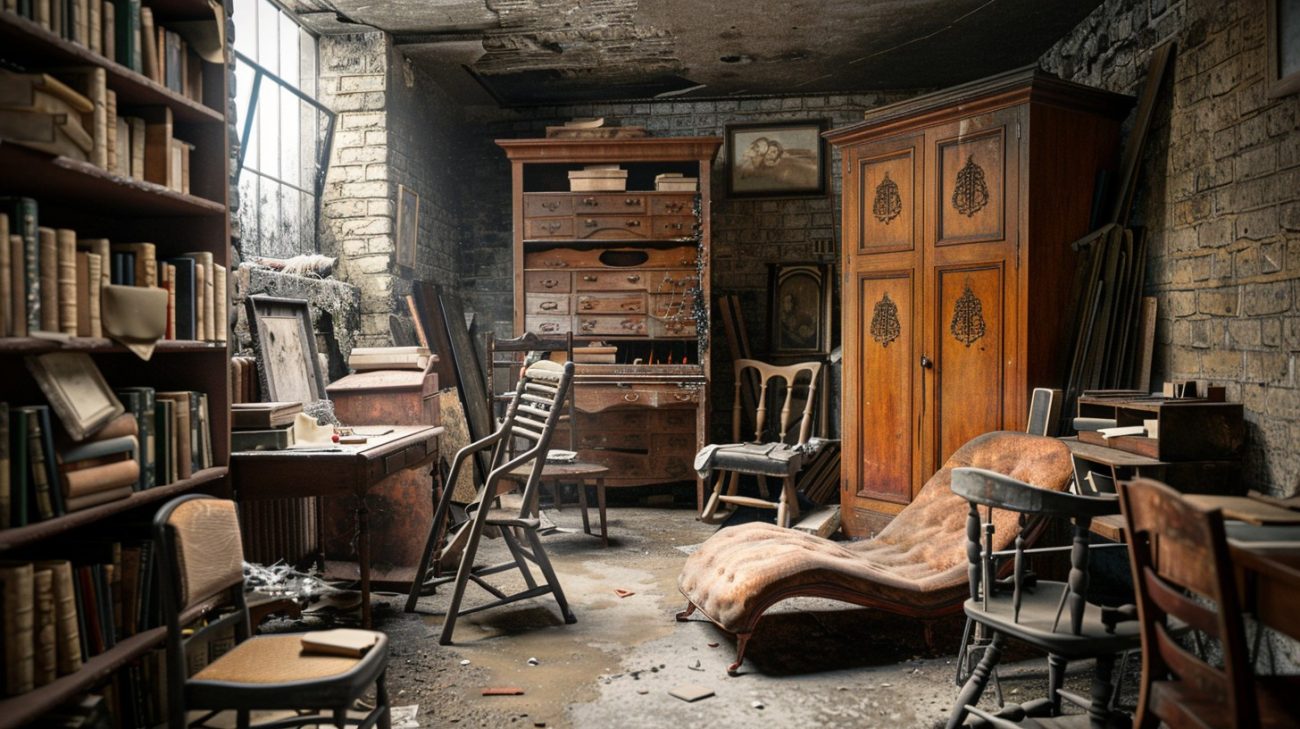
The contents vary, but the patterns are consistent. Almost every Highgate basement I have visited contains at least one piece of antique furniture deemed too large, too fragile, or too unloved for the rooms above. Often there are stacked dining chairs, a redundant writing desk, a rolled carpet or two, boxes of silverware wrapped in cloth that has not been changed in a decade, framed pictures leaning against damp walls, and trunks of textiles – curtains, tablecloths, upholstery fabric – that the owner fully intends to do something with eventually. The intention is kind. The environment is not.
What Damp Does to Antiques Over Time
Damp is not dramatic. It does not announce itself the way a flood does, or leave the obvious watermarks of a burst pipe. It works slowly, invisibly, and by the time most people notice the results, the process has been going on for years. Understanding what it actually does to different materials is essential before you attempt to clean or restore anything that has been living in it.
Wood, Fabric, and the Slow Damage
Wood absorbs moisture from its environment constantly, swelling and contracting with changes in humidity. Antique furniture, which is often made from dense hardwoods and joined with animal-hide glues that were never designed for sustained dampness, responds to chronic high humidity by warping, splitting along the grain, and losing the integrity of its joints. Veneers lift. Drawers cease to fit their openings. Finishes bubble and peel from within. The damage is structural, not just cosmetic, and cleaning the surface does nothing to address it.
Fabric suffers differently but equally badly. Upholstery on antique pieces stored in damp conditions will develop mould on the underside and deep within the stuffing, long before it is visible on the surface. The fibres weaken, the colours shift, and the smell – that particular sweetish-musty note that clients sometimes describe as “old house” – is often mould rather than age.
Metal and Paper – the Faster Casualties
Metal and paper respond to damp faster than wood and fabric, and less forgivingly. Silver and brass tarnish rapidly in humid conditions, but the tarnish itself is relatively benign compared to what happens when moisture is trapped beneath a layer of old polish or cloth wrapping – the combination creates an acidic microclimate that can pit and corrode the surface permanently. Framed pictures and documents are perhaps the most vulnerable of all: paper absorbs moisture and becomes brittle as it dries, the support distorts, and foxing – those brownish-orange spots caused by mould and oxidisation – spreads across the surface in ways that a conservator can partially address but never fully reverse.
How I Assess and Clean What Comes Up from Below
When a client wants antiques brought up from the basement and returned to the house, the cleaning process does not begin with a cloth. It begins with a proper assessment of what condition each piece is actually in – which is a different question from how dirty it looks.
The Check Before the Cloth
Before cleaning anything that has come out of a damp basement, I check four things. First, the joints and construction – any looseness, any visible separation, anything that moves when it should not. Second, the finish – whether it is intact, lifting, or entirely gone in patches. Third, the smell, which tells you whether mould is present even when it is not yet visible. Fourth, any active moisture: a piece that still feels cold and slightly clammy to the touch has not finished adjusting to its new environment and should be left in a drier space for at least several days before cleaning begins. Cleaning a piece that is still actively releasing moisture will simply redistribute the problem.
Cleaning Damp-Affected Surfaces
Once a piece has stabilised, the cleaning approach depends on what the damp has actually done. For wooden surfaces where the finish is intact, the method is essentially the same as for any antique wood – minimal moisture, soft cloths, appropriate wax or oil for the wood type – but applied with extra caution around joints and edges. Where the finish has lifted or been compromised, cleaning must stop well short of any restoration work, which belongs to a furniture conservator rather than a cleaner.
For metal that has tarnished in storage, a gentle polish is appropriate – but only after checking carefully for any pitting beneath the tarnish. Polish on a pitted surface will fill the recesses temporarily and make the damage harder to see, which is not the same as fixing it. For fabric and upholstery, surface dust can be removed with a low-suction vacuum and a brush attachment, but anything that smells of mould should be assessed by a textile specialist before any cleaning is attempted.
Getting Antiques Out of Harm’s Way
Cleaning damp-affected antiques is only useful if the conditions that caused the damage are also addressed. A mahogany bureau cleaned and polished and returned to the same basement will simply begin the same process again.
Addressing the Basement Itself
The most practical thing a homeowner can do is install a dehumidifier and run it consistently – not occasionally, but as a permanent fixture of the space. A reading of 45 to 55 per cent relative humidity is the target. Beyond that, improving ventilation where possible, checking that any damp-proofing on the walls is still effective, and ensuring that items stored below ground are raised off the floor on wooden pallets or shelving rather than placed directly on stone or tile will make a significant difference. None of this requires major building work. It requires attention, which is both cheaper and more effective.
Knowing When the Damage Has Already Won
Some pieces that have spent years in a Highgate basement cannot be saved by cleaning. Warped carcasses, delaminated veneers, foxed canvases, and fabric eaten through by mould are conservation problems, not cleaning problems, and treating them as the latter only wastes time and risks further harm. Part of my job – and not the least important part – is telling a client honestly when the right person to call is a conservator or a restorer rather than me. The basement reveals the history. What you do with that information is what matters.
